

Selection guide
Choosing an Electric Shaker Bottle: A Buyer's Selection Guide
Published
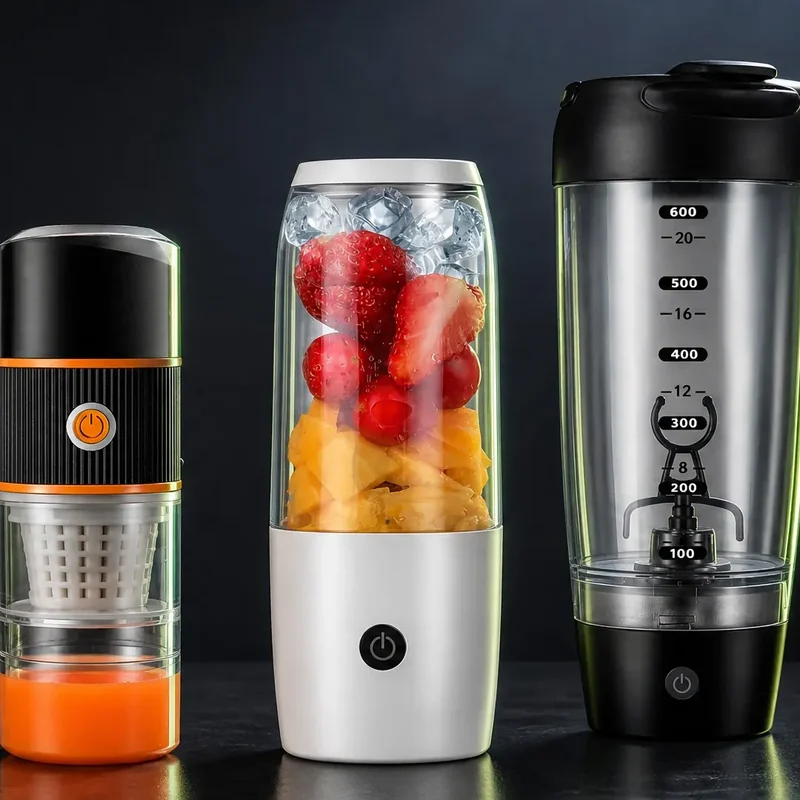
How to narrow 29 models across four categories down to the right one, using capacity bands, mixing method, material and power source as the four filters.
Our catalogue lists 29 models across four categories, capacities 260 ml to 800 ml. That is a lot to compare at once, and most buyers narrow it down the wrong way — starting with price, or with the model a competitor is selling. The four filters below each eliminate models for a reason you can defend to your buying team.
Four categories, and what actually separates them
Categories are defined by the mechanism inside the cup, not the shape of the bottle — two products can look almost identical and sit in different categories.
| Category | Models | What the mechanism does |
|---|---|---|
| Shaker bottle | 15 | Mixes powder into liquid — protein, meal replacement, supplements |
| Portable blender | 6 | Breaks down fruit, ice and solids, not just powder |
| Smart stirring cup | 7 | Stirs automatically, often with insulation or a display |
| Juice separation cup | 1 | Separates juice from pulp rather than blending everything together |
The useful question is what your buyer will put in it: if the answer is always powder and water, the blender and juicer models are irrelevant. If customers complain that powder clumps, the answer is usually a higher-rpm or magnetically driven unit.
Filter 1: capacity band
Capacity is the fastest way to cut the list. The range divides into four bands, and most markets have a clear preference among them.
| Band | Models in this band |
|---|---|
| 260–350 ml | P3 (260 ml Tritan / 200 ml glass), VX60 (300 ml), FL2 (300 ml), 2030 (340 ml), V10 (350 ml), V6 (350 ml) |
| 380–500 ml | BBJ01 (380 / 480 ml), P9T (400 ml), V27 (450 ml), 203 (470 ml), 25500 (500 ml), P2020R (500 ml), 24350 (500 ml), EMC013 (500 ml) |
| 530–650 ml | VX70 (530 ml), ZZ01 (600 ml), P2060R (600 ml), B22078R (600 ml), VX90 (630 ml), 23652D (650 ml), 23650 (650 ml), 24165 (650 ml), P2501R (650 ml) |
| 700–800 ml | 25700 (700 ml), 25701 (700 ml), 012 (700 ml), EMC012-S (700 ml), 25702 (730 ml), VX100 (800 ml) |
As a working rule: 260–350 ml suits single-serve use; 380–500 ml suits the mainstream gym and commuting segment; 530–650 ml suits meal-replacement and full-day use; 700–800 ml suits buyers wanting one container for both drinks and blended food.
Filter 2: mixing method
Once capacity has cut the list, the mechanism decides the rest. There are three distinct approaches in our range, and they are not interchangeable.
- Motor-driven paddle — the widest group, spanning 6,500 to 8,000 rpm where a speed is published. The standard, most cost-effective approach for dissolving powder.
- Magnetic drive — used on the smart stirring range, including the 9,000 rpm models. The stirring element is magnetically coupled, so the drive section separates fully from the container.
- High-speed blending — the 20,000 rpm model, built to break down fruit and ice. A blender in a bottle format rather than a shaker; specify it when the end customer will put solids in.
A common mistake is specifying a stirring unit for a market where customers want to blend fruit. The reverse error costs more: buying a 20,000 rpm blender to mix protein powder means paying for capacity the customer never uses.
Filter 3: material
Material choice follows the market rather than the use case:
- Tritan — the most common body material, chosen for clarity and impact resistance.
- Borosilicate glass — used on glass-body models, including one offered in both a glass and a Tritan version.
- 316 stainless steel — used as an interior liner on insulated models, where thermal performance matters.
- PC — used on one AAA-powered model, with food-contact PP for the parts that touch liquid.
One practical point: food-contact documentation is usually required for glass and stainless models as well as plastic ones, so the material does not remove the paperwork requirement.
Filter 4: power source
The rechargeable range uses 500 mAh, 1,200 mAh and 1,500 mAh cells, charged over USB with Type-C on most models. One model runs on two AAA batteries instead of a built-in cell — and that matters more than it looks: where customers are wary of built-in batteries, a battery-powered unit removes a purchase objection and avoids the shipping restrictions lithium cells bring.
Where to start
A shortlist of four models covering the range's four different answers: V10 (350 ml, entry capacity, design-led), VX60 (300 ml, compact and washable), VX100 (800 ml, the largest capacity with a 1,200 mAh cell and 9,000 rpm magnetic drive), and FL2 (300 ml, the only juice separation model — a different job from the other 28).
Take those four as a starting point, not a recommendation: which is right depends on the market, the price point and what your customer puts in the cup. Minimum order quantities vary by model and pricing is confirmed on quotation; some models start as low as one piece for sampling.
Related models
Models referenced in this article.
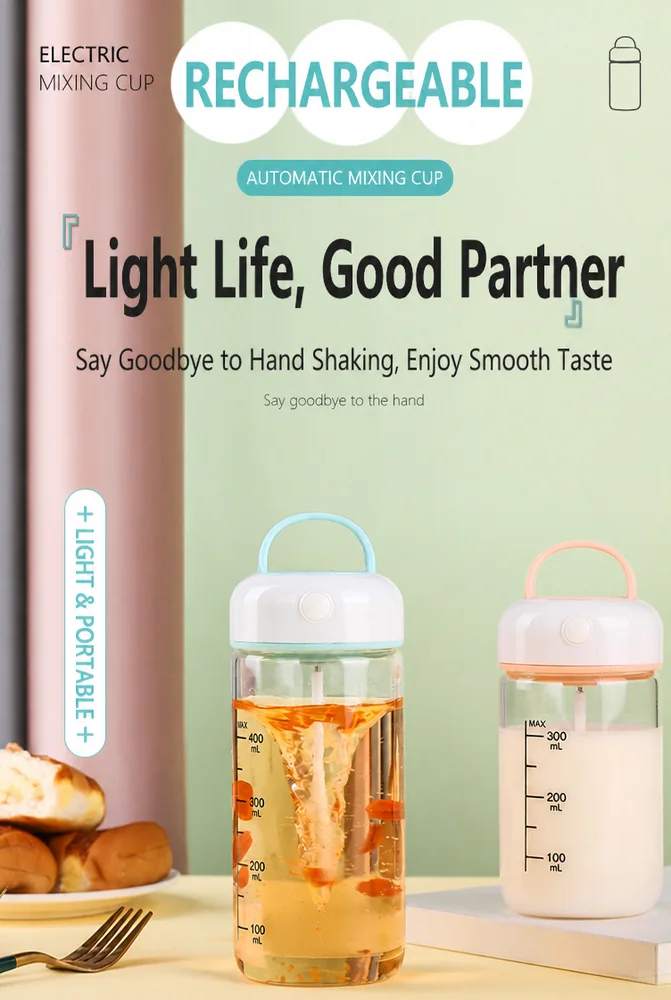
Model: BBJ01
BBJ01 Glass Electric Stirring Cup, 380-480 ml
A borosilicate glass stirring cup for coffee and powdered drinks, running at 7,000 rpm. Available in glass or PC, so you can choose the body that suits the market.
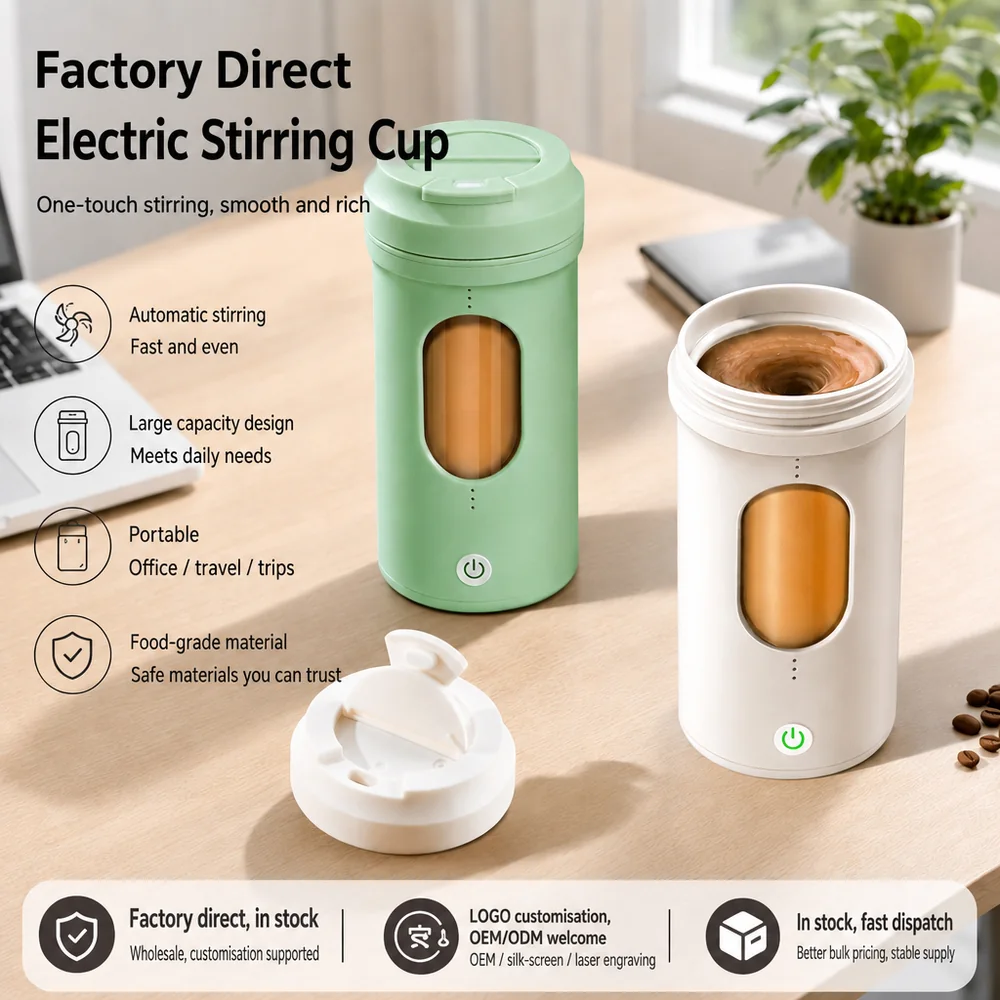
Model: VX60
VX60 Electric Stirring Cup, 300 ml
A 300 ml single-serve stirring cup - one coffee or one soy milk. Tritan, bottle-grade body, a seagull whisk for a smoother blend, and the highest water resistance in the range.
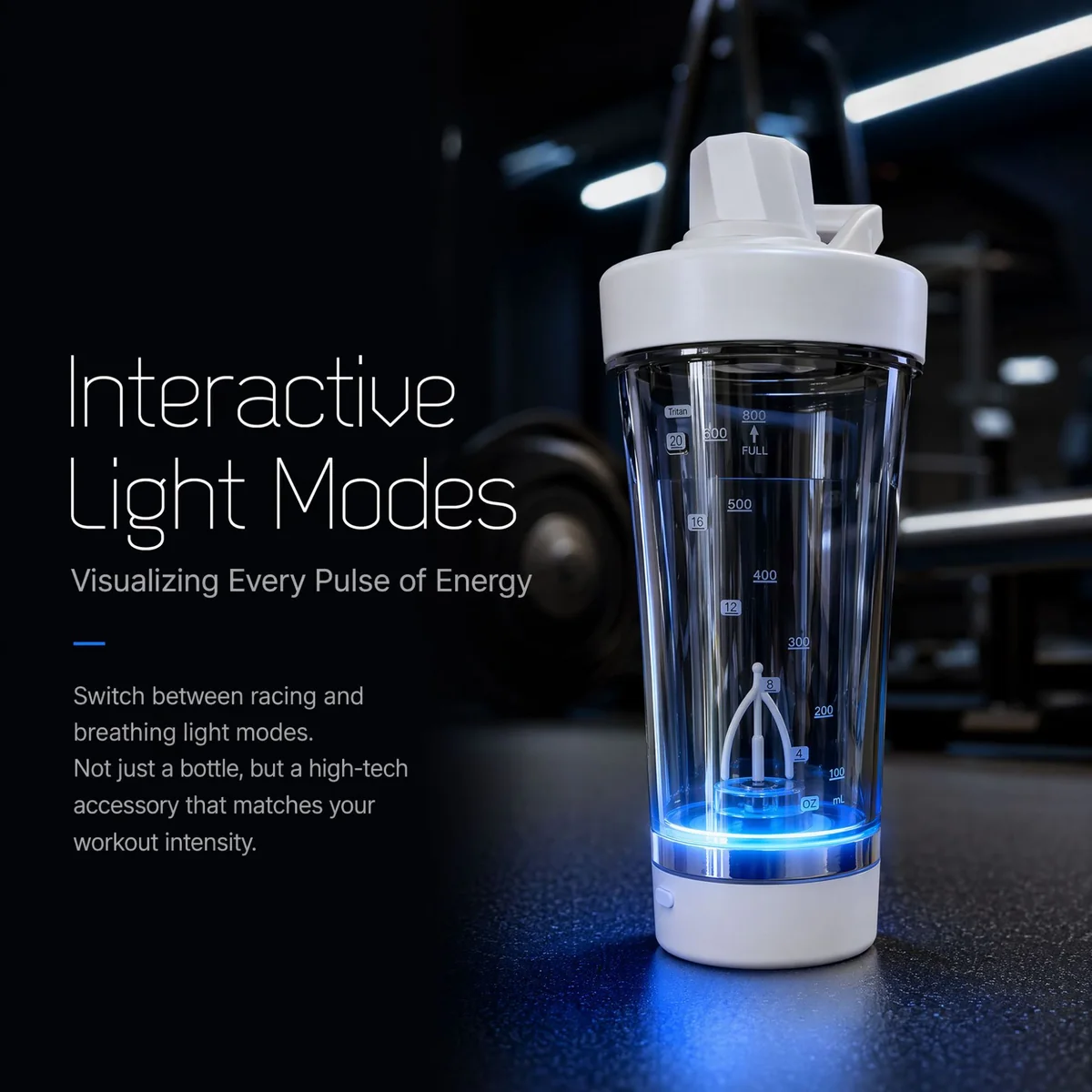
Model: VX100
VX100 Magnetic Self-Stirring Cup, 800 ml
An 800 ml cup that stirs with a magnetic rotor rather than a blade, so there is nothing sharp to clean. Tritan body with a 316 stainless liner, a base that separates, and an IPX6 whole-unit wash.
Enquire about this model
Send your target quantity, market and branding requirements — we reply with a quotation and sample lead time.