

Technology
Electric Shaker Bottle Technology: Motors, Cells and Sealing
Published
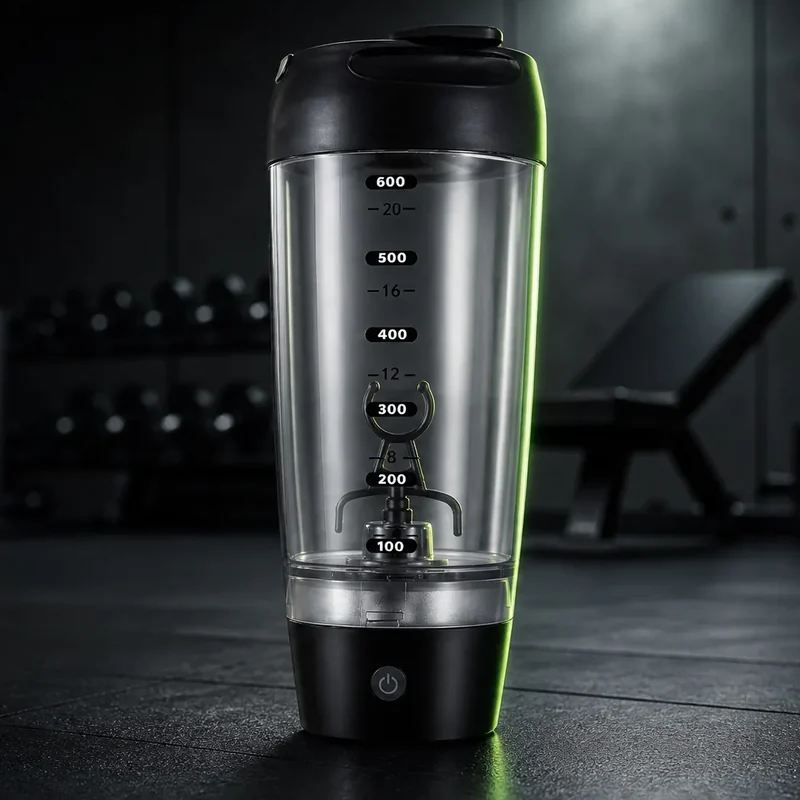
What 6,500 to 20,000 rpm actually means, how the battery and charging range is structured, and how sealing and food-contact materials are specified.
Three specifications decide how an electric shaker bottle performs in use: how fast the motor turns, how the unit stores and delivers power, and how well it is sealed. This article takes each in turn and explains what the numbers mean — and which numbers are actually published for a given model.
Motor speed: why one number is not enough
Across our range, published motor speeds run from 6,500 rpm to 20,000 rpm. That span exists because the models are built for different jobs, not because one unit is simply better than another.
| Model | Category | Published motor speed |
|---|---|---|
| EMC013 | Smart stirring cup | 6,500 rpm |
| VX60 | Shaker bottle | 6,500 rpm |
| 23652D | Shaker bottle | 7,000 rpm |
| 25702 | Shaker bottle | 7,000 rpm |
| BBJ01 | Shaker bottle | 7,000 rpm |
| VX70 | Shaker bottle | 7,000 rpm |
| 012 | Shaker bottle | 8,000 rpm |
| EMC012-S | Shaker bottle | 8,000 rpm |
| VX90 | Smart stirring cup | 9,000 rpm |
| VX100 | Smart stirring cup | 9,000 rpm |
| P2501R | Portable blender | 20,000 rpm |
The range splits into two groups. The 6,500–9,000 rpm units are stirring devices: they combine powder, meal replacement or water, and need torque at moderate speed rather than maximum revolutions. The 20,000 rpm model is a blending device, built to break down fruit and ice rather than dissolve powder.
One honest note: not every model publishes a motor speed figure, and a model absent from this table is not necessarily lower-specification — it means the figure is not published. Ask for the specific model rather than inferring from the category.
Battery and charging
The rechargeable range uses three cell capacities — 500 mAh, 1,200 mAh and 1,500 mAh — plus one model running on two AAA batteries instead of a built-in cell. Higher capacity generally means more mixing cycles between charges, though cycles per charge depends on run time per cycle as much as on the cell.
| Power source | Used by |
|---|---|
| 500 mAh cell | VX70 |
| 1,200 mAh cell | 23652D, 23650, VX90, VX100 |
| 1,500 mAh cell | EMC012-S |
| 2 × AAA batteries | V6 |
Charging on the rechargeable models is over USB, with USB Type-C used across most of the range including the shaker, smart stirring cup and portable blender lines. Type-C is worth specifying for export markets because it removes a separate wall-adapter decision in most cases.
Some models also carry a 7.4 V pack rather than a 3.7 V one. The voltage figure describes how the cells are configured, not a performance rating on its own — a 7.4 V pack and a 3.7 V pack can deliver similar mixing results through different motor and drive designs.
Water resistance and cleaning
Washability is the specification buyers most often get wrong, because "waterproof" means three different things: splash-resistant, washable under a running tap, and fully submersible. Within our range the published ratings span IPX6 to IPX8, and most models publish no IP rating at all — so this is a per-model figure, not a range-wide claim.
- IPX6 — VX100 and EMC012-S, rated for whole-unit washing; the VX100 base also detaches.
- IPX7 — VX70, rated for whole-unit water resistance.
- IPX8 — VX60, rated for rinsing; supplied in battery and Type-C versions.
- Separable base — on several models, including ZZ01, where water does not reach the motor.
- No published rating — most of the catalogue; check the model's own specification before making a washability claim.
A removable or separable base is a different specification from an IP rating, and a buyer planning a cleaning-instruction claim on packaging needs to know which one they are describing.
Food-contact materials
Everything that touches the drink is specified as a food-contact material. Which one depends on the model and on the market:
- Tritan — clarity and impact resistance, used on many bottle bodies.
- 316 stainless steel — used as an interior liner on insulated models.
- Borosilicate glass — used on glass-body models, including one offered in both a glass and a Tritan version.
- Food-grade PP — used for lids, bases and internal parts.
- PC — used on one AAA-powered model, with food-contact PP for the parts in contact with liquid.
Materials are declared per model rather than across the range, so read the material line per product rather than once for the catalogue.
Reading a specification sheet correctly
These three specifications are often compared using a single headline number each, which hides more than it reveals: a 9,000 rpm stirrer and a 20,000 rpm blender are not competing products, a 500 mAh cell and a 1,500 mAh cell are not interchangeable, and an IP rating and a removable base answer the same cleaning problem differently. Read the full specification line for the model you are considering. Minimum order quantities and pricing are confirmed on quotation and vary by model.
Related models
Models referenced in this article.
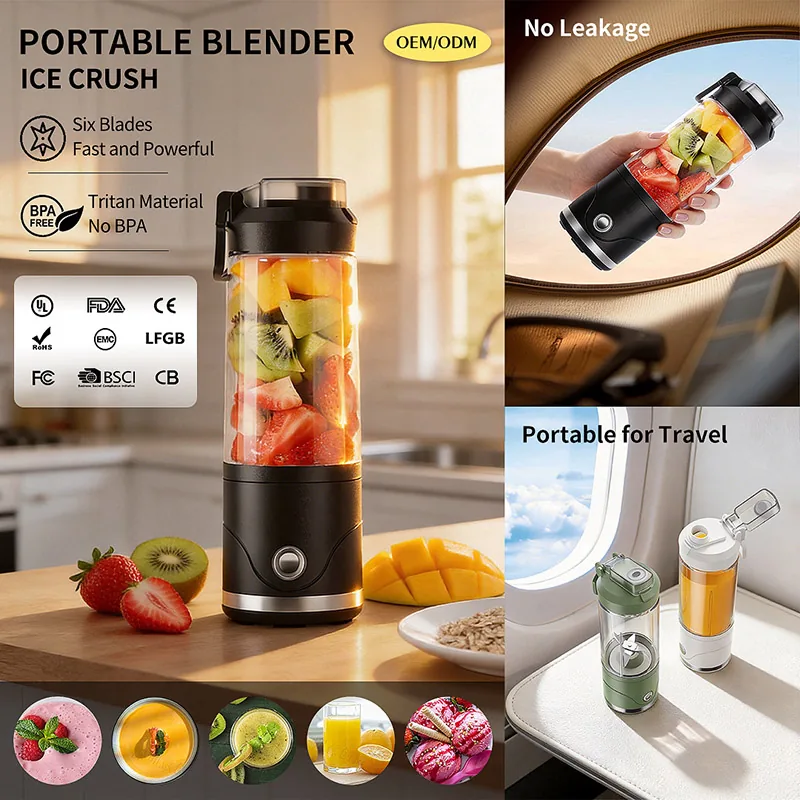
Model: P2501R
P2501R 75 W Portable Juicer Blender, 650 ml
75 W portable juicer cup running at 20,000 rpm with stainless-steel 304 blades, a 650 ml cup and USB charging.
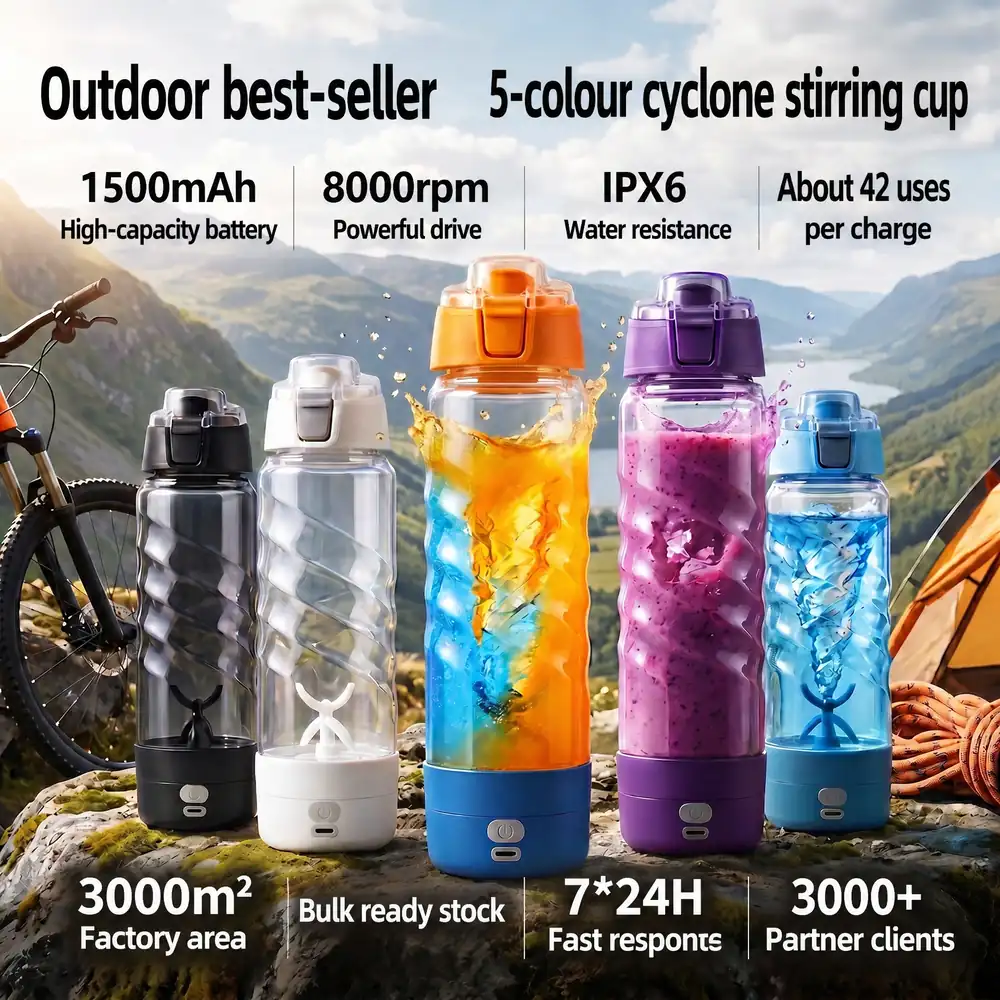
Model: EMC012-S
EMC012-S Electric Stirring Cup, 700 ml
A 700 ml outdoor stirring cup with an 8,000 rpm motor, a 1,500 mAh battery good for about 42 uses per charge, and IPX6 whole-unit water resistance. One press starts it and it stops itself after 30 seconds.
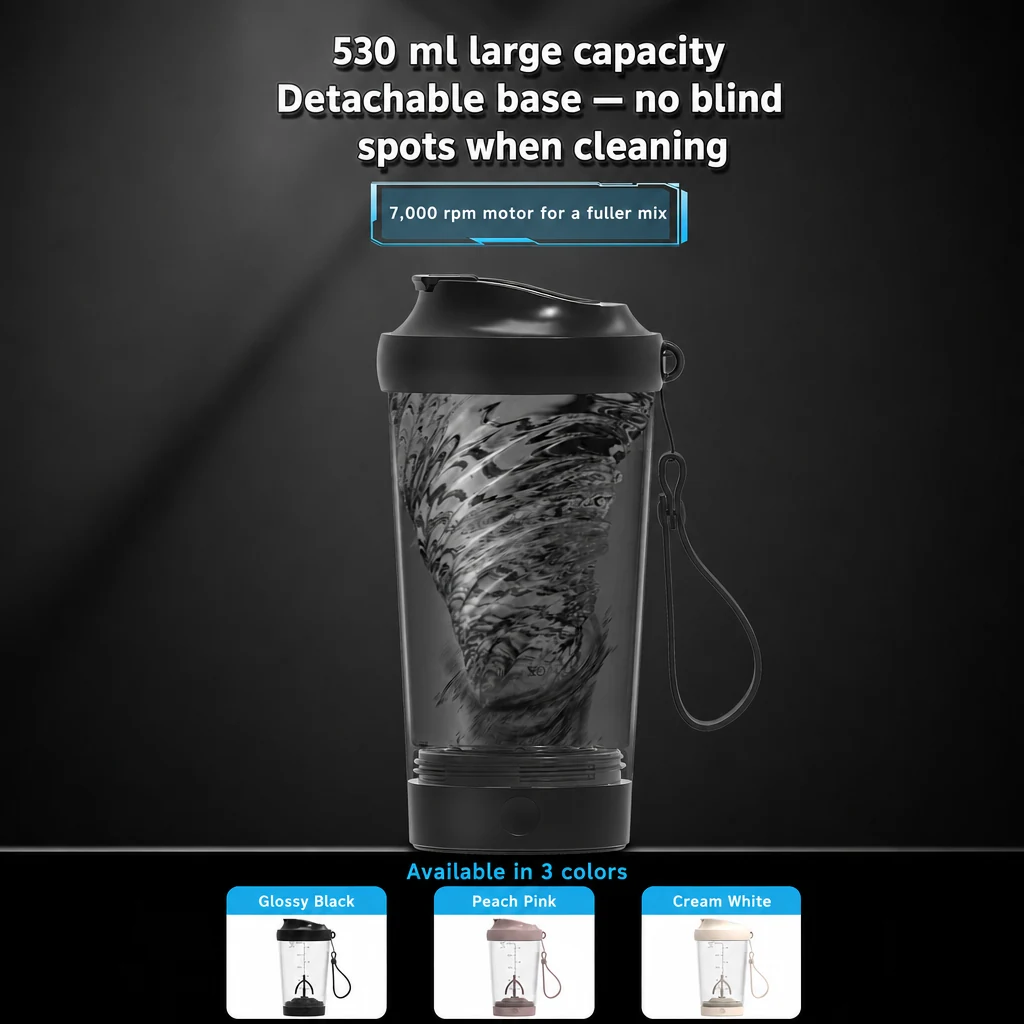
Model: VX70
VX70 Electric Mixing Cup, 530 ml
A 530 ml mixing cup with a 7,000 rpm motor and a base that unscrews, so the whole cup can be rinsed without blind spots. The body carries a dual oz/ml scale and a carry loop; a version with a protective sleeve is also available.
Enquire about this model
Send your target quantity, market and branding requirements — we reply with a quotation and sample lead time.